











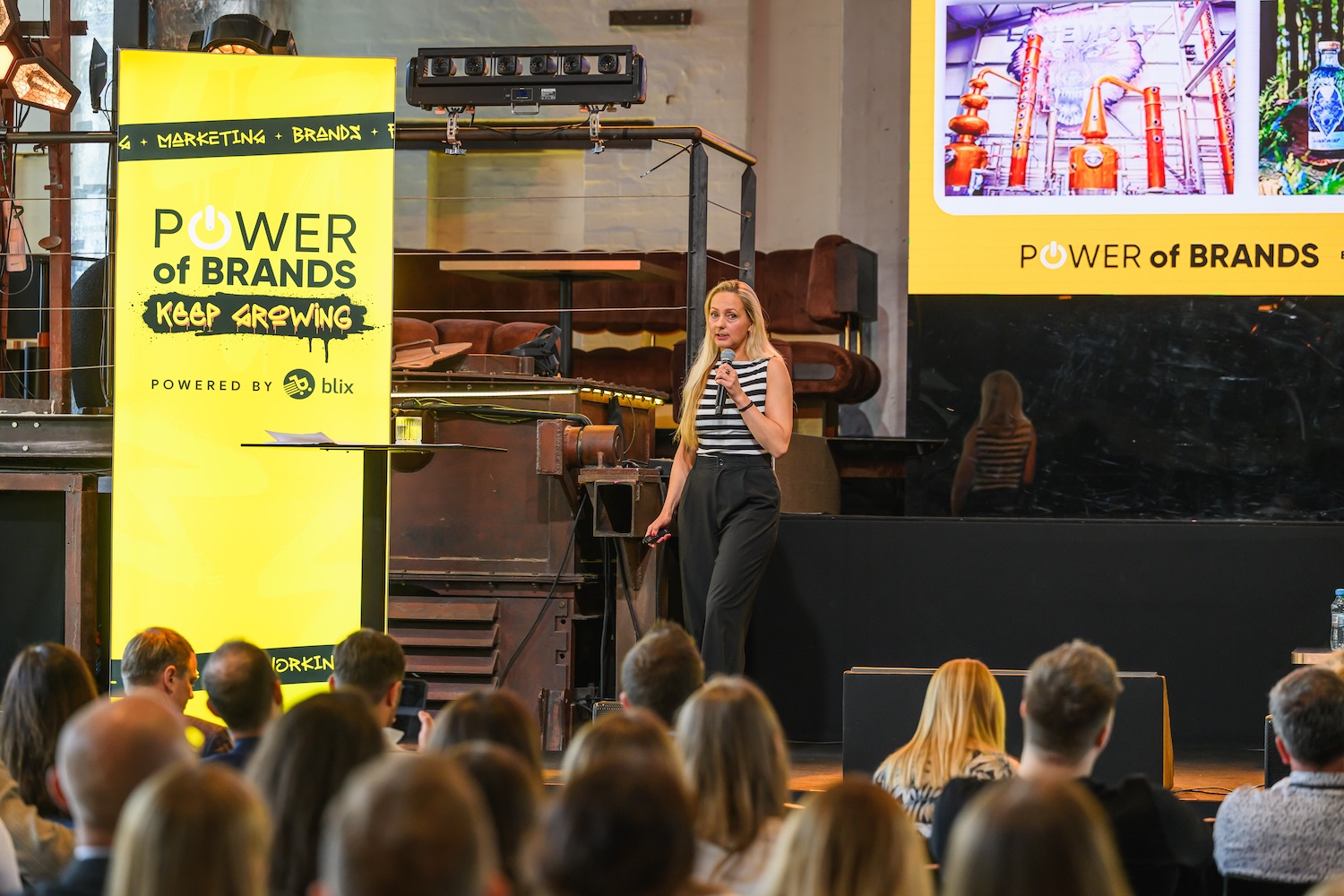
This article is based on the presentation Magda Adamska, founder of BrandStruck, gave in June 2026 at the Power of Brands Conference.
In recent years, the discourse around brand growth has centred on the principles associated with the Ehrenberg-Bass Institute: growing penetration through customer acquisition, building mental and physical availability and strengthening distinctive brand assets. It would be easy to conclude that brands shrink when they fail to follow those practices.
The picture is less tidy than that. Plenty of brands have declined because of the business decisions they made, regardless of how well they applied the Ehrenberg-Bass fundamentals.
Having analysed the strategies of hundreds of global brands, we keep seeing the same four scenarios in which brands that were commercially successful for years end up shrinking. They are summarised in the matrix below.
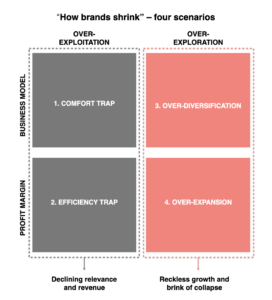
Two of them come from over-exploitation (left side of the matrix), meaning an excessive focus on extracting value from the existing business model (scenario 1) or on squeezing the profit margin (scenario 2).
The other two (right side of the matrix) come from over-exploration, meaning growth pursued in too many directions, at the expense of a focused business model (scenario 3) or a healthy profit margin (scenario 4).
The over-exploitation route often follows a similar pattern. The brand starts out enjoying strong financial results, then stops growing and begins to contract. Revenues fall, competitors take the space and the brand becomes irrelevant.
The over-exploration route might look healthier for longer, because revenues often keep rising. The damage shows up in the business model, which becomes too broad to manage or in the P&L, when the cost of funding expansion outgrows what the business earns. Sometimes both.
1. Comfort trap: MTV
MTV is an example of a brand that held on to its business model for too long and, as a result, lost its place in young people’s lives to YouTube, Spotify, Netflix and TikTok.
The last time MTV was included in Interbrand’s ranking of the world’s 100 most valuable brands was in 2016 and it has never made it back. At the end of 2025, the MTV music channels closed worldwide.
It might be perplexing that a brand with such deep cultural equity could fade into near-irrelevance. How did MTV, a brand with strong relationships across record labels, artists and the wider music industry and decades of experience clearing global music rights, not build something like Spotify? Why didn’t it buy YouTube when it (reportedly) had the chance and instead chose to sue it over copyright infringement? Why didn’t it go fully digital and start creating and commissioning content for online platforms at scale?
The core problem was MTV’s attachment to its legacy business model.
The brand was so focused on being a television channel that it didn’t invest enough in digital, simply because in the short and medium run digital wouldn’t have delivered the profit TV ratings could. It also failed to see that the real danger came not from other TV networks but from tech companies. Businesses that understood technology, but also product design, data, user behaviour and how to use marketing to build scale.
Spotify launched in 2008 and reported its first annual profit in 2024. If it had been created inside Viacom, MTV’s owner, it would probably have been shut down by the early 2010s.
2. Efficiency trap: Nike
Nike‘s commercial difficulties of recent years are often attributed to new brands such as On and Hoka entering the market and taking share. However, most business analysts point to a set of self-inflicted decisions, driven by the goal of improving profit margin without adequate assessment of the long-term effect on revenue and profit.
During the COVID lockdowns, Nike’s online sales grew sharply, as they did for most brands. The company treated that spike as a new baseline and underestimated how much of it would disappear once conditions normalised. Encouraged by the results, it moved aggressively to a direct-to-consumer (DTC) model in the early 2020s under then-CEO John Donahoe, ending long-standing partnerships with major wholesale retailers including Foot Locker and Macy’s. That handed shelf space to emerging competitors.
As Nike concentrated on driving traffic to its own website and apps, marketing priorities shifted towards performance at the expense of long-term brand building. Frequent promotions followed, used to hit short-term targets that had become harder to reach without retail partners. Together, these decisions diluted brand equity and eroded Nike’s premium positioning, leaving consumers less willing to pay full price.
Under Elliott Hill, Nike is now refocusing on brand building, restoring key wholesale relationships and renewing its commitment to product innovation, but the recovery is likely to take years.
3. Over-diversification: GoPro
After many successful years, GoPro’s growth slowed down, largely because the niche it was targeting remained relatively narrow. Most of the people interested in buying GoPro products already owned them and were disinclined to upgrade to newer models as older-generation products still performed well. In an effort to sustain growth, the company made a few business decisions aimed at expanding its user base. Although the objective was sound, the changes contributed to the brand’s decline.
At first, GoPro tried to widen its audience by persuading ordinary consumers, rather than extreme sports enthusiasts, to use a GoPro instead of their phone camera in everyday situations. Since this strategy never gained traction, GoPro started exploring riskier approaches. It launched the Karma series of video drones, but they faced major technical issues, including a tendency to fall from the air and were eventually withdrawn from production.
The most damaging decision, though, was GoPro’s attempt to transform itself into a media company. As GoPro cameras enabled users to create vast amounts of unique video footage, the company, inspired by Red Bull‘s success, aimed to become a content outlet, with “shareability” as a key objective. It experimented with a business model where content was free to watch but required payment for commercial use, hoping to create an additional revenue stream. GoPro invested heavily in developing more than 30 original series and launching a streaming platform, but none of these initiatives were officially rolled out, as the company began facing problems with its core business – largely because resources had been diverted to these new endeavours.
It remains debatable whether the GoPro expansion strategy was flawed or whether its implementation was too rushed, but its share price dropped by more than 90% within a few years.
4. Over-expansion: BrewDog
Within a few years of launch, BrewDog became one of the fastest-growing businesses in the UK and started building a global presence. However, in March 2026, it entered administration and was acquired by Tilray Brands for £33 million, a fraction of its peak valuation of nearly £2 billion just a few years earlier. As a result, around 220,000 Equity for Punks shareholders were wiped out and multiple UK bars were closed.
Public attention has focused on the toxic workplace culture as the main reason for the collapse, but that wasn’t what brought the company down.
While a few factors played a role, including the over-diversification discussed in the previous point (a beer manufacturer and a pub operator are already two distinct businesses and adding hotels, spirits, a TV channel, a beer school and charter flights pushed the model too far), the main problem was over-expansion.
BrewDog opened more than 100 bars worldwide, mainly in the UK, and only 18 of them operated as franchises. Owning and running the bars rather than franchising them is a costly strategy at the best of times. It becomes even more expensive when the expansion is funded largely through high-interest borrowing, with some of BrewDog’s loans reportedly carrying rates of up to 18%. Revenues grew, but not fast enough to cover the cost of servicing the debt. The company has not reported an annual profit since 2019 and accumulated losses of £148 million over five years.
Lessons
Analysing a brand’s decline from the outside is easy in hindsight. Almost any of these four scenarios could be a sound strategy under the right conditions and whether a set of decisions counted as over-exploitation or over-exploration usually becomes clear only after the fact. Looking at these cases, it is tempting to conclude that there is no way to win. Protecting the core too much or expanding too fast as well as squeezing the margin or ignoring it can all end badly. Still, there are a few lessons that can be learnt.
1. Do not build new categories in-house when you have to learn them from scratch
Launching a new beer variant when you’re a beer producer is one thing. Becoming a streaming platform, when you manufacture cameras, is another.
2. Every category has an optimal margin level and pushing past it causes long-term problems
Optimisation looks good on paper in the first year or two, but the real bill arrives later, usually in the form of quality problems, insufficient share of voice, weakened distribution after cutting out intermediaries and customer service deterioration that drives customers away.
3. Never build a long-term strategy based on data from an atypical period
A temporary craze, a viral success, a pandemic or any other crisis will generate numbers that might look like a trend. Mistaking one for the other is expensive, because people and their habits change slowly.
—–
If you want to read the complete brand strategy case studies of all brands mentioned in this post, as well as many more, subscribe to BrandStruck.
If you need help with research or want to hire Magda for a strategy project, email her at magda@brandstruck.co
To subscribe to our newsletter, simply email your address to brandstruck@brandstruck.co with the subject line ‘Newsletter’.



Magda Adamska is the founder of BrandStruck.
https://www.linkedin.com/in/magda-adamska-32379048/
BrandStruck is the only online database of brand strategy case studies.
BrandStruck’s mission is to empower brand builders worldwide with the best brand strategy practices and insights, showcased through 250+ case studies of the world’s most admired brands.